
We often think of the human body as a collection of parts—muscles, bones, joints, and nerves—working together like a machine. But that model barely scratches the surface. What really powers our athleticism is an adaptable, intelligent network of connective tissue called fascia. And when we train with fascia in mind, we unlock our full potential as athletes.
Built to Move, Born to Run
Millions of years of evolution have shaped us into a species uniquely designed to run, throw, and adapt. The shift from tree-dwelling ancestors to long-distance runners on the African savanna gave rise to specialized fascia structures like the plantar fascia, Achilles tendon, and IT band. These tissues are designed to absorb force, store elastic energy, and release it like a spring—what Bill Parisi calls the “catapult effect.”
Unlike machines, our bodies are self-healing, adaptive, and capable of remodeling based on the loads we place on them. This makes training a powerful biological tool—especially when we understand how fascia works.
The Kangaroo Effect: Efficiency Through Elasticity
Think of a kangaroo bounding across a field. With each landing, its tendons stretch and recoil, propelling it forward with minimal energy cost. Humans have the same built-in system. When we jump, run, or bound, our fascia acts like a rubber band, loading with gravity and ground reaction force, then releasing that energy through coordinated motion.
This is why rhythm and timing matter so much. Proper coordination of muscle contraction and relaxation—governed by the nervous system—ensures we use that stored energy efficiently. Lose the rhythm, and the spring-like power disappears.
Training the System: Power, Speed, and Resilience
Modern fascia-aware training includes more than just lifting heavy or stretching. It requires dynamic, multi-planar movement, rhythm, and intent. Here are a few key strategies pulled from the science:
1. Plyometrics with Short Contact Times
Bouncy movements like hops, skips, and bounds build stronger springs by increasing collagen density and crosslinks in fascia. The shorter the contact time, the more elastic recoil you train.
2. Barefoot Training
Our feet are loaded with fascia designed for shock absorption and energy transfer. Running or training barefoot (or in minimalist shoes) strengthens this system and improves proprioception. Start with short sessions on soft surfaces and build gradually.
3. Heavy Bag Punching
Throwing and striking are some of the most fascia-dependent movements we perform. Punching a heavy bag with full-body force teaches coordination, timing, and balance—especially when you focus on staying grounded and generating force from the feet up.
4. Neurological Precision and Muscle Slack
Your nervous system recruits muscles in order of size and effort. But to convert strength into power, you also need to turn muscles off just as fast as you turn them on. Training tools like plyometrics, unstable surfaces, and explosive lifts help reduce muscle slack and sharpen force production.
The Spinal Engine and the Power of Rotation
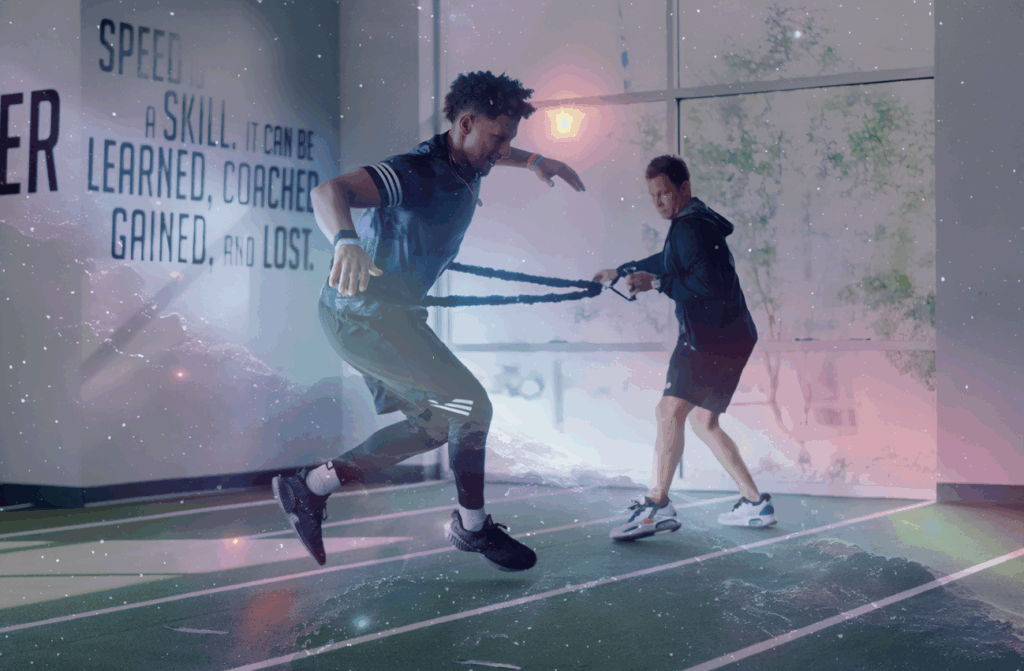
Legendary performance coach Bobby Stroupe (trainer of NFL superstar Patrick Mahomes) explains it best: the spine acts as a force amplifier. It’s not generating power, but it’s essential in transferring and accelerating force through the body—especially in rotational movements like throwing, swinging, or punching.
This “spinal engine” plays a huge role in sports performance. Stroupe’s approach layers in strength, stability, and speed throughout the week, gradually ramping up to game-like velocities. This variability in load, velocity, and time under tension builds resilient fascia and highly adaptable athletes.
Movement Is the Message
Whether it’s bounding up stairs with springy cadence, throwing a punch that travels from foot to fist, or running barefoot through grass, the fascia system thrives on movement with intention. It adapts to the patterns and forces we give it—so every rep, every step, every bounce matters.
And perhaps most important: fascia-aware training isn’t just for pro athletes. It’s for anyone who wants to move better, feel stronger, and train smarter. The goal isn’t just to get more powerful—it’s to move like a human was built to move.
FASCIA TRAINING
IN ATHLETIC PERFORMANCE CERTIFICATION
Virtual Mentorship Program
Designed for coaches, trainers, and movement professionals who want to deepen their understanding of fascia’s critical role in speed, power, injury resilience, and overall athletic development.