


Modern humans might carry smartphones and sip protein shakes, but at our core, we’re still wired like the primal hunters who once chased antelope across the savannas of Africa. Millions of years of evolution didn’t just shape our appearance—they engineered our fascia system into a high-performance biological machine built to run, throw, and survive.
Understanding that history can help athletes and coaches unlock more efficient, powerful, and injury-resilient training strategies. Welcome to the fascia-aware approach.
The Human Bio-Machine
Fascia is the body’s internal suspension system—a web of connective tissue that wraps around muscles, tendons, and organs. It transfers force, stores elastic energy, and responds to stress with structural remodeling. But here’s the thing: your fascia isn’t just a passive structure—it’s the result of millions of years of evolutionary design.
From the plantar fascia in your feet to the thoracolumbar fascia in your back, your fascia system has been shaped by the physical demands our ancestors faced—primarily running and throwing.
Why We Were Born to Run
According to evolutionary biologists like Daniel Lieberman, one of the biggest shifts in human development happened 2.5 million years ago when climate change turned East Africa into a dry savanna. To survive, our ancestors evolved the ability to run long distances—possibly using “persistence hunting” to exhaust prey. This shift led to fascia-dense adaptations like the Achilles tendon, the IT band, and the plantar fascia, all of which help store and return energy with every step.
Our unique fascia architecture allows us to use gravity and ground reaction force as free energy. Think of it like a kangaroo’s bounce—an elastic propulsion system powered by rhythm and recoil. Plyometric movements (like jumping or bounding) activate this system and help it grow stronger, denser, and more resilient.
Throwing: The Fascia-Driven Superpower
Running may have kept us alive, but throwing made us lethal. No other animal can throw with the force, accuracy, or coordination of a human. It’s not about raw muscle—it’s about fascia and timing. When a baseball pitcher launches a 90-mph fastball, much of that force is generated during the elastic wind-up—not the arm muscles themselves. The thoracolumbar fascia, nuchal ligament, and shoulder connective tissue act as catapults, storing energy during the loading phase and releasing it with lightning speed.
This elastic system is why throwing and punching movements are such effective fascia training tools. Heavy bag work, for example, helps athletes learn to ground themselves, generate rotational force from the feet up, and deliver force through the kinetic chain with balance and precision.
Rhythm, Recoil, and Reactivity
Timing is everything in fascia-driven movement. Whether bounding up stairs or throwing a punch, the body uses rhythmic pulses of muscular stiffness and neural firing to remove slack and deliver force. This concept—called pre-tension—is key to maximizing the catapult effect. The better your nervous system can quickly co-contract and relax the right muscles, the more efficient your movements become.
This is why elite athletes don’t just move fast—they recover between movements with equal precision. Research from Dr. Stuart McGill shows elite UFC fighters and drummers share a unique neuromuscular pattern: quick spikes of activity followed by controlled silence. That relaxation between efforts is just as important as the strike itself.
The Spinal Engine and Sport-Specific Power
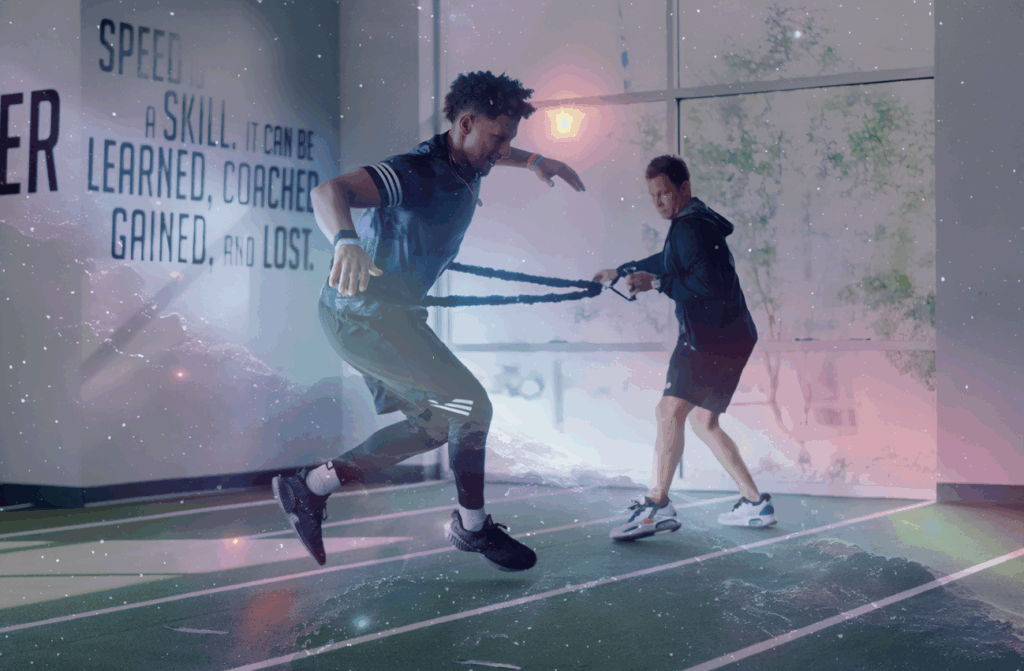
Rotational power doesn’t just come from your arms or hips—it gets amplified through the spine. Performance coaches like Bobby Stroupe (who trains Patrick Mahomes) emphasize the role of the “spinal engine” in transferring and enhancing force. Think of it as hitting the nitro button mid-movement. Proper spinal mobility and control allow athletes to throw, swing, and strike with greater power—even in off-balance or mid-air positions.
Fascia-aware training includes heavy loading, plyometric work, and rotational drills that challenge the body in unpredictable ways. Stroupe structures his in-season programming with early-week strength work, mid-week tendon-focused power, and high-speed neural training closer to game day.
Practical Fascia-Aware Tools
So how do you train the fascia system?
- Barefoot training: Running or lifting barefoot activates the foot-ankle complex and improves balance, proprioception, and elastic loading. Transition slowly if you’re used to cushioned shoes.
- Heavy bag work: Teaches rotational force production, rhythm, and ground-based power. Start with jab-distance punches and focus on timing and footwork.
- Plyometrics: Short-contact jumps, bounds, and hops increase collagen density and enhance recoil.
- Velocity-based training: Using tools that track speed and load helps target specific adaptations in fascia and muscle.
Final Thoughts
The fascia system is more than just connective tissue—it’s a living, dynamic structure that responds to the way we move. Whether you’re sprinting, throwing, or rebounding off the floor, fascia is the common thread. And when you train it with intent, rhythm, and variability, you don’t just move better—you move like a human was built to move.
FASCIA TRAINING
IN ATHLETIC PERFORMANCE CERTIFICATION
Virtual Mentorship Program
Designed for coaches, trainers, and movement professionals who want to deepen their understanding of fascia’s critical role in speed, power, injury resilience, and overall athletic development.